
Why Your Succulents Keep Dying (And What Heavy Base Drainage Actually Fixes)
Heavy base drainage succulents thrive when their soil dries out fast — and the right substrate minerals make all the difference. Here’s a quick summary of the best materials to use:
| Drainage Mineral | Best Use | Key Benefit |
|---|---|---|
| Pumice | All succulents, especially indoor | Lightweight, highly porous, promotes airflow |
| Scoria (lava rock) | Mixed substrate layers | Rough texture encourages root growth |
| Coarse grit/gravel | Base drainage layer | Prevents compaction, rapid water movement |
| Perlite | Soil amendment | Increases aeration, widely available |
| Horticulture charcoal | No-hole pots | Absorbs impurities, reduces odor |
The quick answer: Use a mix of at least 50-66% inorganic minerals (pumice, scoria, or coarse grit sized 1/8″ to 1/4″) blended with a quality potting mix. Your soil should dry out completely within about 3 days of watering.
Succulents store water in their leaves, stems, and roots. That’s their superpower — and their Achilles heel. When soil stays wet too long, those same water-storing tissues become breeding grounds for rot. Fast.
The problem isn’t usually how much you water. It’s how fast the soil drains and dries.
Most standard potting mixes hold far too much moisture for succulents. Adding the right heavy drainage minerals to your substrate — or choosing the right base layer for a decorative pot without holes — is what keeps roots healthy for months or even years.
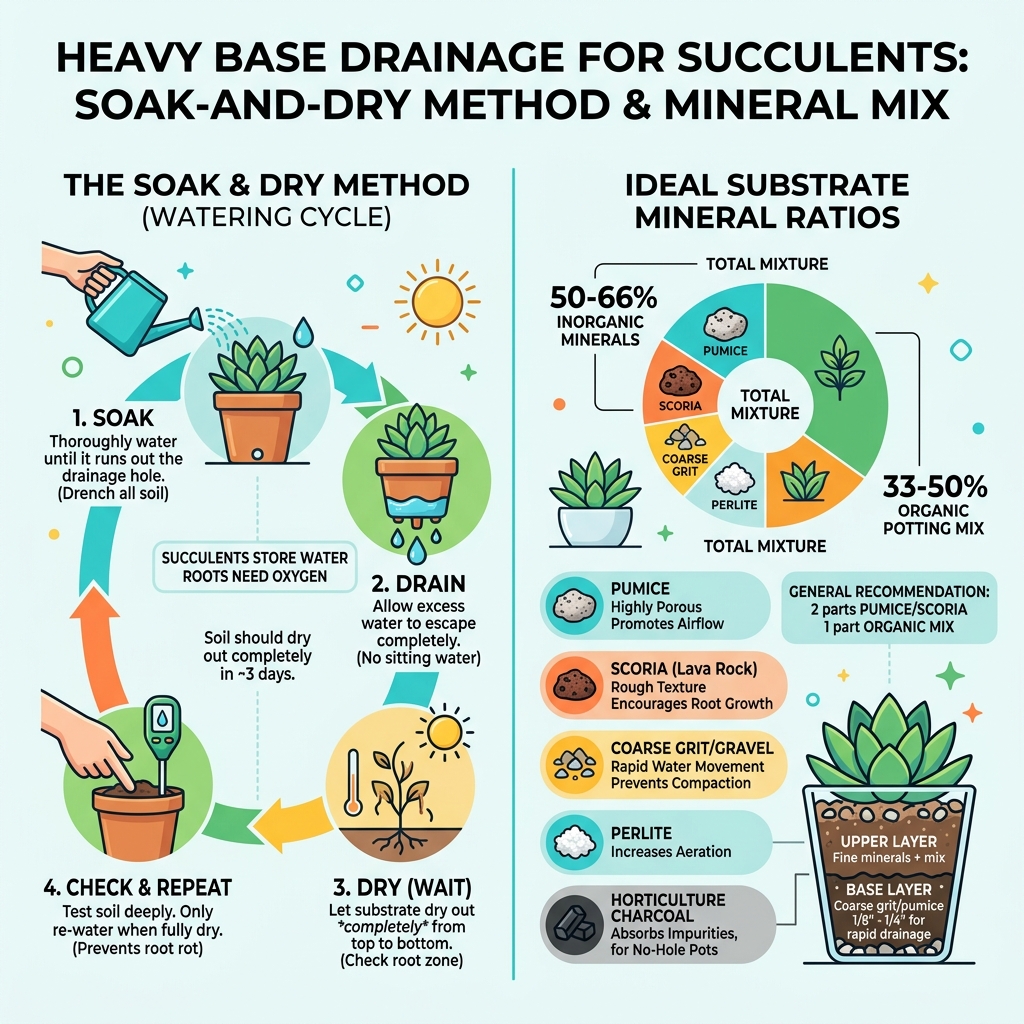
Why Heavy Base Drainage Succulents Need Specialized Substrates
We’ve all been there: you find the most beautiful succulent at the nursery, bring it home, and within three weeks, it’s a mushy, brown mess. The culprit is almost always “wet feet.” Because succulents are adapted to arid environments, their roots need a constant cycle of soaking and drying. If the soil stays damp, the roots literally suffocate.
Proper drainage is critical because it facilitates aeration. Roots need oxygen just as much as they need water. When we use heavy, organic-rich soil, the water fills every tiny pore, pushing out the air. Specialized substrates for heavy base drainage succulents solve this by using large, inorganic particles that create “macro-pores”—big air pockets that water can’t easily clog.
The Problem with the Perched Water Table
There is a common gardening myth that putting a layer of rocks at the bottom of a pot with a drainage hole helps it drain better. Science actually tells us the opposite! In a pot with a hole, a layer of gravel can actually raise the “perched water table,” meaning the soggy layer of soil stays closer to the roots rather than further away.
However, when we are dealing with pots that have no drainage holes, we have to change our strategy. In those cases, a heavy base layer acts as a reservoir to keep the roots from sitting directly in the water. To avoid these common pitfalls, we recommend checking out our guide on preventing-overwatering-of-succulents-indoors to understand the delicate balance of moisture.

The Science of Heavy Base Drainage Succulents and Soil Ratios
When we talk about “grit,” we aren’t just talking about sand. In fact, fine sand can be a succulent’s worst enemy because it packs down like concrete, choking the roots. For potted succulents, we want coarse grit minerals that are about 1/8″ to 1/4″ in diameter. This size is the “Goldilocks” zone—large enough to allow rapid drainage but small enough to provide stability for the plant.
A classic starting ratio for succulent soil is 1:1 (half organic soil and half inorganic grit). However, depending on your environment, you might need to go even heavier on the minerals. Many experts suggest a 1/3 organic to 2/3 mineral ratio to ensure the substrate fully dries in about 3 days.
| Mineral | Porosity | Weight | Best Feature |
|---|---|---|---|
| Pumice | High | Light | Best for aeration; doesn’t float like perlite. |
| Scoria | Medium | Medium | Rough surface helps roots “grip” and grow strong. |
| Perlite | High | Very Light | Cheap and easy to find, but can blow away or migrate to the top. |
For more tailored advice on what to put in your pots, see our indoor-garden-soil-recommendations.
Mastering Pots Without Holes: The Layering Technique
We know the feeling—you find a vintage tea cup or a gorgeous glazed ceramic pot, and it doesn’t have a single hole in the bottom. While we always prefer pots with drainage, you can make no-hole pots work if you create a “drainage layer” or a heavy base.
The goal here is to create a space where excess water can sit away from the roots. We start with a 1-2 inch layer of heavy materials like gravel, lava rock, or pebbles.
The Magic of Horticulture Charcoal
One of our favorite secrets for no-drainage pots is adding a 1/2 inch layer of horticulture charcoal over the rocks. Charcoal is porous and acts like a filter. It absorbs impurities, prevents the “stagnant water” smell, and helps keep the environment around the roots fresh.
After the charcoal, we add our high-grit soil mix. When planting, we like to position the root ball slightly above the rim of the pot to prevent water from pooling around the crown of the plant. If you’re feeling nervous about this setup, Succulents In Pots Without Drain Holes: Planting & Care Tips offers great visual inspiration for these decorative projects.
Selecting the Best Heavy Base Drainage Succulents for No-Hole Pots
Not all succulents are created equal when it comes to moisture tolerance. If you are experimenting with a low-drainage environment, we recommend starting with hardier varieties that have evolved to handle varied moisture levels.
- Haworthia Cymbiformis: Known as the “Cathedral Window Haworthia,” this plant has translucent leaf tips that allow light to penetrate deep into the plant. It’s incredibly resilient and handles container life well. You can learn more about its specific needs in this Haworthia Cymbiformis: The Ultimate Care and Propagation Guide.
- Haworthiopsis coarctata: This plant grows in tall, striking columns. It is quite tolerant of being slightly underwatered, which is perfect for no-hole pots where you want to err on the side of caution. Check out the Haworthiopsis coarctata Care Guide for more tips.
- Gibbaeum heathii: A unique, globe-like succulent that mimics the stones it grows amongst in the wild. It is highly adapted to arid conditions and is a great candidate for heavy base drainage setups. Read more at Gibbaeum heathii | PlantZAfrica.
Advanced Watering Strategies for Low-Drainage Environments
Watering a pot without a hole requires a different mindset. You aren’t “soaking” the soil until water runs out the bottom; you are providing a measured amount of hydration.
We recommend using tools that allow for precision. A turkey baster or a narrow-tipped squeeze bottle is perfect for directing water exactly where it needs to go—into the soil, not on the leaves. For a deeper dive into these techniques, see our guide on best-watering-methods-for-indoor-succulents and drip-watering-succulent-guide.
The “Tipping” Method
If you suspect you’ve accidentally added too much water to a pot without a hole, don’t panic! Simply place your hand over the soil (to keep the plant in place) and tip the pot sideways over a sink. This allows excess water to run out of the drainage layer before it can saturate the soil. This simple trick has saved many of our favorite “heavy base” plants.
Seasonal Adjustments
Succulents need much less water in the winter. During their dormancy period, we might only water once every 3-4 weeks. In a pot without drainage, this is even more important. If you’re unsure how to water in a tricky container, How to Water Succulents in Pots with No Drain Holes provides excellent practical advice.
Monitoring Moisture in Heavy Base Drainage Succulents
How do you know what’s happening beneath the surface? One interesting technique involves using fibered sphagnum moss. This moss can absorb up to twenty times its weight in water. Some growers use a thin layer of it between the drainage rocks and the soil to help distribute moisture more evenly and prevent soil from washing down into the rock layer.
However, be careful—sphagnum moss holds moisture, so use it sparingly in humid environments. We also recommend using fans to mimic natural wind, which helps with surface evaporation and prevents the growth of fungi. For more on managing your home’s microclimate, visit indoor-succulent-moisture-control.
Troubleshooting and Long-Term Maintenance
Even with the best heavy base drainage succulents and substrates, things can go wrong. The most common sign of trouble is yellowing, mushy leaves at the base of the plant. This is a classic symptom of root rot.
If you see this:
- Unpot the plant immediately.
- Inspect the roots. Healthy roots are firm and white; rotted roots are black and slimy.
- Trim the rot. Use a sterilized blade to cut away any decayed tissue.
- Let it dry. Leave the plant out in the air for a few days to callous over before repotting in fresh, dry, gritty soil.
Another common issue is mealybugs—tiny white insects that look like bits of cotton. They love the humid crevices of overwatered plants. You can treat them by dabbing them with a cotton swab dipped in rubbing alcohol. For help identifying these issues early, check our guides on signs-your-succulent-needs-water and common-watering-mistakes-with-succulents.
Ecological Adaptations of Arid Species
Understanding where these plants come from helps us care for them. Take Haworthia truncata var. truncata, for example. In its native South African habitat, it grows almost entirely underground, with only the flat “window” tops of its leaves exposed. This protects it from the sun and helps it conserve moisture. You can find a detailed botanical profile at Haworthia truncata var. truncata | PlantZAfrica.
Other species, like the Haworthia Limifolia (or “Fairy Washboard”), have evolved ridges on their leaves to help capture dew and channel it toward the roots. These plants are masters of efficiency. By providing them with a high-mineral substrate, we are simply mimicking the rocky outcrops and sandy loams they call home. For more on this ridged wonder, see the Haworthia Limifolia Care Guide or the Cultivating the Fairy Washboard guide.
Frequently Asked Questions about Succulent Drainage
Can I use regular potting soil for succulents?
We don’t recommend it. Standard potting soil is designed to hold moisture, which is the opposite of what a succulent wants. If you must use it, amend it with at least 50% pumice, perlite, or coarse grit to improve the drainage.
Is a layer of rocks at the bottom enough for drainage?
In a pot without a hole, a layer of rocks creates a necessary reservoir for excess water. In a pot with a hole, it is actually better to use well-mixed gritty soil throughout the entire pot to avoid raising the water table.
How often should I water succulents in pots without holes?
There is no set schedule, but generally, you will water less frequently than in a pot with holes. Always wait until the soil is bone-dry all the way to the bottom. In winter, this might mean watering only once a month.
Conclusion
At SecureFinPro, we believe that every plant lover should be able to use their favorite decorative pots without fear. By mastering the art of heavy base drainage succulents and choosing the right substrate minerals like pumice and charcoal, you can create a thriving indoor garden that lasts for years.
The key is to remember that succulents are survivors. They would much rather be a little too dry than a little too wet. With a bit of grit (literally!) and the right watering techniques, your “un-drainable” pots can become the centerpiece of your collection. For more expert advice and plant care tips, explore our full category/succulent-care section. Happy planting!
