
The Most Common Signs of Overwatered Succulents
The signs of overwatered succulents are easier to spot than most people think. Here’s a quick summary:
Common signs of an overwatered succulent:
- Leaves look yellow, see-through, or translucent
- Leaves feel soft and mushy to the touch
- Leaves fall off with the slightest bump
- Stems turn black or brown at the base
- Soil stays wet for days after watering
- Mold or fungus gnats appear on the soil
Succulents are built to survive drought. Their thick, fleshy leaves act like tiny reservoirs, a characteristic common to succulent plants found in arid environments. Think of each leaf as a water balloon — it can hold a lot, but fill it too much and it bursts.
That bursting is exactly what happens when you water too often. The cells swell, break down, and begin to rot.
Overwatering is, by far, the most common way succulent owners accidentally kill their plants. It’s not a lack of care — it’s usually too much of it.
The tricky part? Early signs are easy to miss. A slightly soft leaf or a bit of yellowing can look like nothing at all. But left unchecked, those small signs can quickly lead to root rot and a plant that can’t be saved.
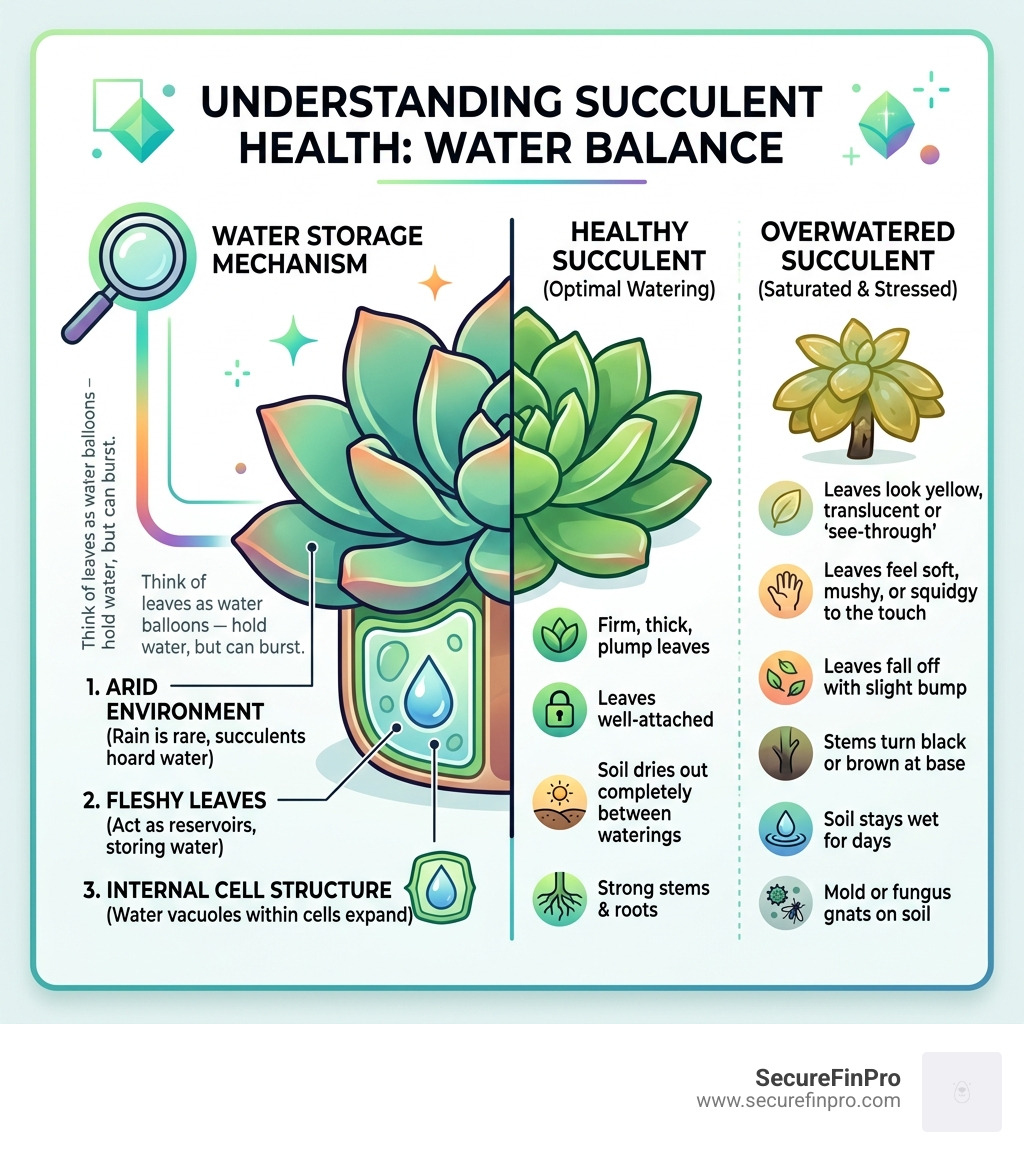
When we talk about the signs of overwatered succulents, we are really looking at a plant that has reached its “saturation point.” Because succulents have evolved in arid environments where rain is a rare luxury, they have developed a “hoarding” mentality. They take in every drop of water they can find. In a pot with too much water, they simply don’t know when to stop drinking.
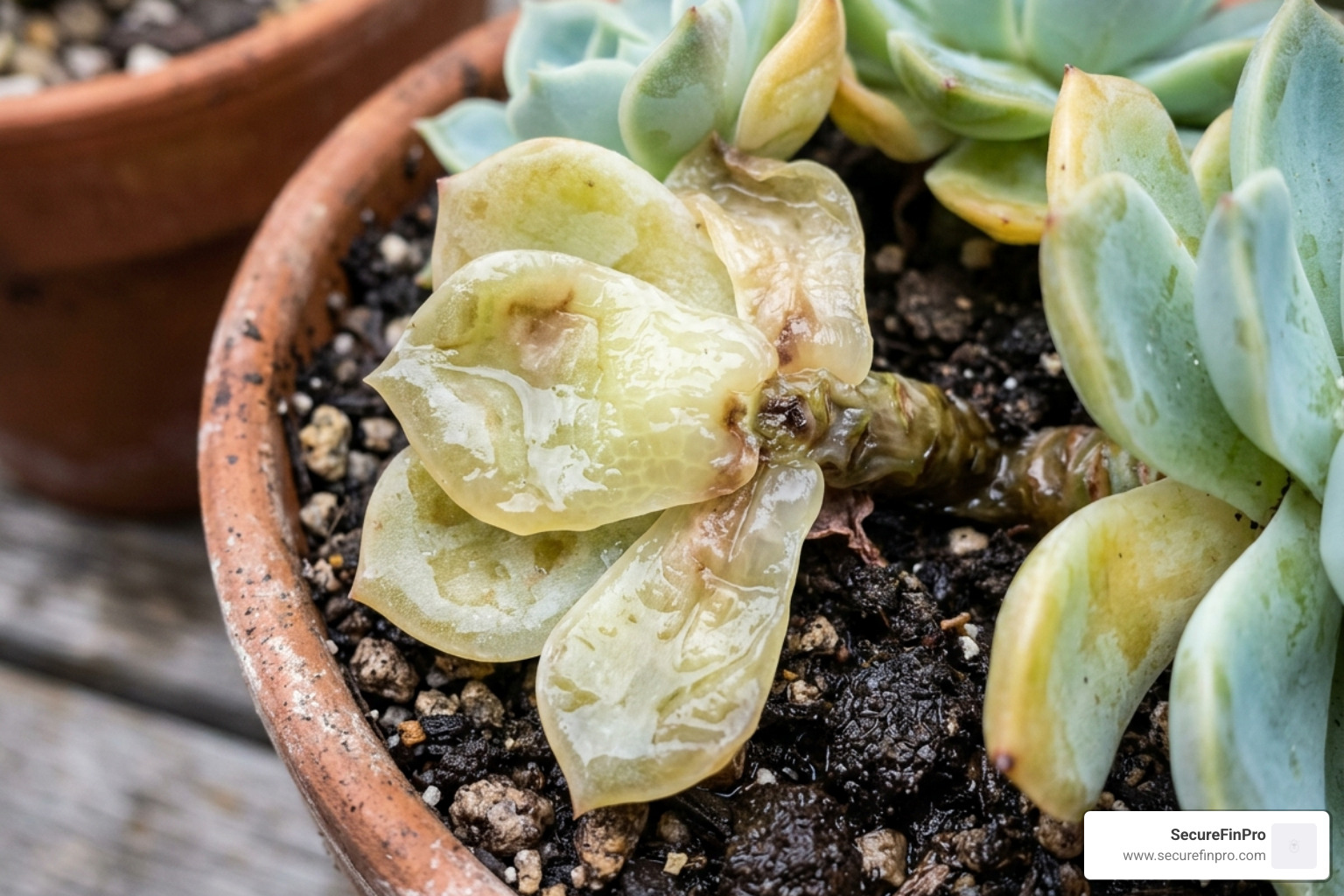
The most glaring indicator is a change in leaf texture and color. A healthy succulent leaf should feel firm, almost like a ripe grape or a piece of plastic. When overwatered, those “water balloons” inside the leaves begin to leak. This results in a translucent skin—the leaf looks see-through or “jelly-like.” You might notice the vibrant greens or reds fading into a sickly, pale yellow.
Beyond the color, the mushy texture is a dead giveaway. If you squeeze a leaf and it feels squishy or leaves a dent, the internal structure has collapsed. This leads to easy leaf drop. In many cases, you don’t even have to pull the leaf off; just brushing against the plant or moving the pot causes several leaves to tumble away. If you want to dive deeper into these visual cues, check out our guide on the-tell-tale-signs-of-an-overwatered-succulent.
Identifying Early Signs of Overwatered Succulents
Catching the problem early is the difference between a quick fix and a dead plant. Before the leaves turn into yellow mush, you might notice soft leaves that aren’t quite translucent yet but have lost their “snap.”
Another early warning is color fading. If your bright purple Echeveria starts looking dull and washed out, it’s often a sign that the roots are struggling with too much moisture. Of course, the most obvious early sign is the soil itself. If the soil remains damp or cold to the touch three or four days after watering, the environment is too wet. We see this often when people use the wrong pots or soil mixes. To avoid these pitfalls, read more about common-watering-mistakes-with-succulents.
Secondary Signs of Overwatered Succulents
If the primary signs are ignored, the plant begins to show more “violent” reactions to the excess water. One such reaction is edema. This occurs when the plant takes up water faster than it can use or transpire it, causing the cells to literally explode. This looks like permanent blisters or bumps on the leaves that eventually turn into corky, brown spots.
Excessive moisture also invites unwanted guests. Fungal spots (black or grey fuzzy patches) may appear on the leaves or the surface of the soil. Furthermore, you might notice tiny black bugs flying around the base of the plant. These are fungus gnats, and they love nothing more than consistently wet organic matter. Maintaining proper indoor-succulent-moisture-control is essential to keeping these pests at bay.
Overwatering vs. Underwatering: How to Tell the Difference
It can be incredibly confusing for beginners because both overwatered and underwatered succulents can look “wilted.” However, the texture tells the true story. An underwatered succulent is thirsty and using up its reserves, making it look thin and wrinkled. An overwatered succulent is drowning, making it look bloated and mushy.
| Feature | Overwatered Succulent | Underwatered Succulent |
|---|---|---|
| Leaf Texture | Soft, mushy, and squishy | Leathery, flexible, but tough |
| Leaf Color | Translucent, yellow, or black | Dull, but usually stays the same color |
| Leaf Appearance | Bloated, “filled to the brim” | Shriveled, wrinkled skin, or “puckered” |
| Leaf Drop | Leaves fall off easily when touched | Leaves stay attached until completely dry |
| Bottom Leaves | Turning yellow/mushy | Turning brown, crispy, and paper-like |
| Soil State | Wet, swampy, or damp for days | Bone dry, pulling away from the pot edges |
One unique sign of a thirsty (underwatered) plant is the growth of aerial roots. These are pink or white hair-like roots that grow out of the stem above the soil. The plant is literally reaching into the air to find moisture. While crispy bottom leaves are a normal part of a succulent’s life cycle, if the top leaves start shriveling, it’s time for a drink. Understanding the nuances of understanding-succulent-watering-requirements will help you make the right call every time.
The Danger of Root Rot and Fungal Infections
If you don’t catch the signs of overwatered succulents in the leaf stage, the problem moves underground. This is where things get serious. Root rot is caused by anaerobic bacteria and fungi that thrive in oxygen-deprived, waterlogged soil.
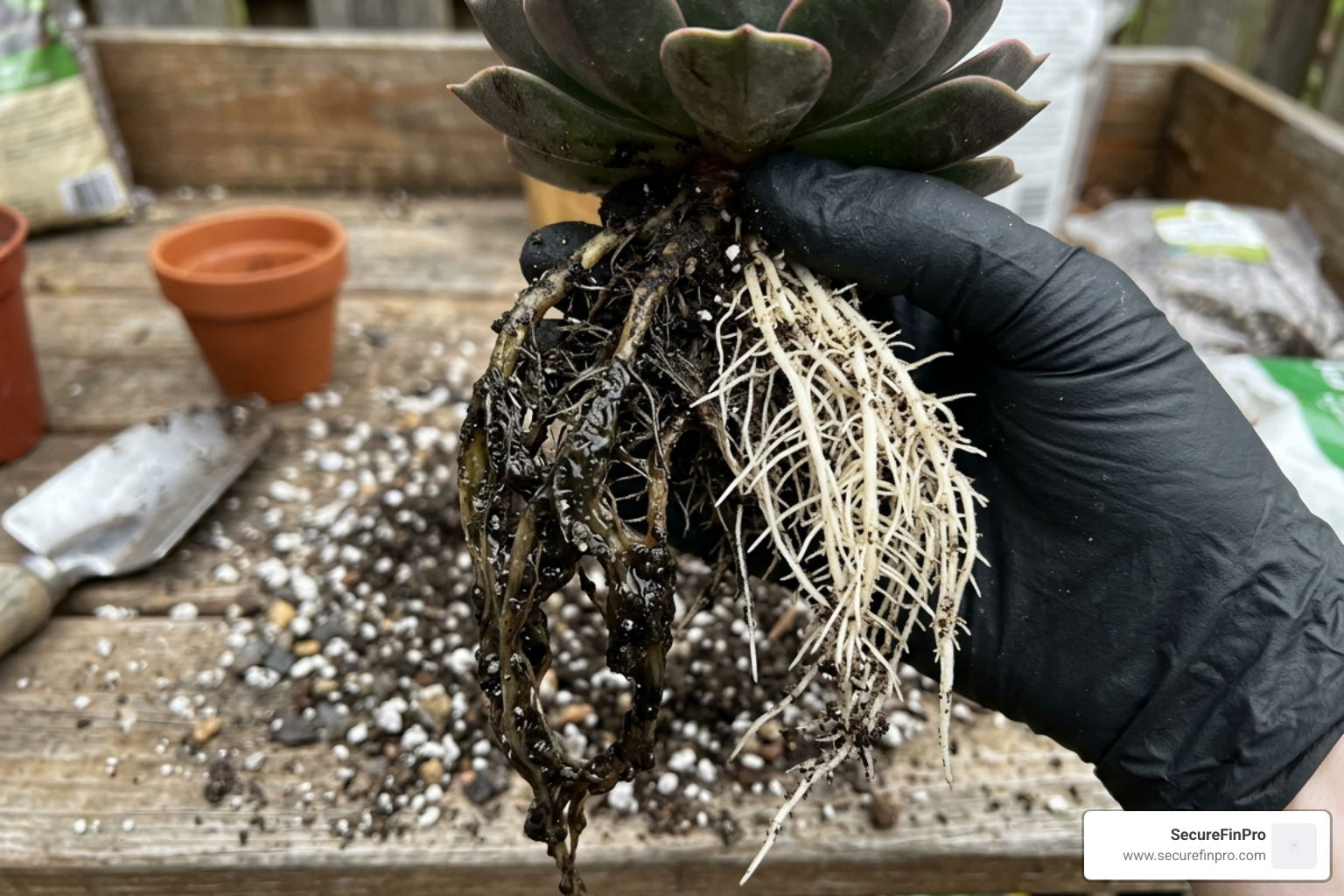
Healthy succulent roots should be white or light tan and firm. Rotted roots are dark, slimy, and black. They often fall apart when you touch them. As the rot progresses, it moves up the “veins” of the plant into the stem. This results in a mushy base and black stems.
Perhaps the most unpleasant sign of advanced rot is what gardeners call the “odor of death.” Because the plant tissue is literally fermenting and rotting, it will emit a sour, swampy smell. Once the stem has turned black all the way through, the plant can no longer transport nutrients. Preventing this stage is the goal of preventing-overwatering-of-succulents-indoors.
How to Save and Repot a Waterlogged Plant
If you’ve spotted the signs of overwatered succulents early enough, there is hope! The first step is to stop watering immediately. Remove the plant from its pot and gently shake off the wet soil.
- Inspect and Trim: Use sterile tools (rubbing alcohol works great) to snip away any black or slimy roots. If the stem is black at the bottom, you must cut into the healthy green tissue until no black spots remain in the center of the stem.
- Air Dry: Leave the plant out of soil in a bright spot (but not direct sun) for 3 to 5 days. This allows the “wounds” to callous over, preventing further infection.
- Propagate: If the main stem is too far gone, don’t lose heart. Pull off any healthy-looking, firm leaves. Place them on top of dry soil, and they may eventually grow brand-new baby plants!
- Fresh Start: Repot the survivor in a fresh potting mix specifically designed for cacti and succulents.
For a step-by-step walkthrough on recovery, see our guide on preventing-overwatering-succulents-indoors.
Best Practices to Prevent Signs of Overwatered Succulents
Prevention is always easier than a rescue mission. To keep your succulents happy, you need to mimic their natural desert home.
- The Right Pot: Always use pots with drainage holes. If the water has nowhere to go, it sits at the bottom and rots the roots. Terracotta pots are excellent for beginners because the clay is porous and actually “breathes,” helping to wick excess moisture away from the soil.
- The Right Soil: Standard potting soil holds too much water. Mix your soil with perlite, pumice, or coarse sand to create a gritty, fast-draining environment. A good test is to wet a handful of soil and squeeze; it should crumble apart, not stick in a ball.
- The Soak and Dry Method: This is the golden rule of succulent care. Instead of giving your plant a “sip” of water every few days, give it a deep soak until water runs out of the drainage holes. Then—and this is the hard part—do nothing until the soil is bone dry all the way to the bottom. This might take one week or three, depending on your home’s humidity.
For more expert advice, check out our top-tips-for-watering-potted-succulents and explore the best-watering-methods-for-succulents.
Frequently Asked Questions about Succulent Care
Can a succulent with a black stem be saved?
Yes, but only if you act fast. You must perform “surgery.” Cut the stem above the black, rotted area. If the “flesh” inside the stem looks clean and green (like a cucumber), the top part can be saved. Let it dry for a few days until a callus forms, then stick it back into dry soil. It will eventually grow new roots!
Why are the bottom leaves of my succulent turning brown and crispy?
If the leaves are at the very bottom of the plant and they are drying up like paper, don’t panic! This is completely normal. As succulents grow new leaves from the center, they “retire” the older leaves at the bottom. Simply pull them off gently and discard them to keep the plant tidy.
How often should I actually water my succulents?
There is no set “schedule” (like every Tuesday). Watering depends on your light, temperature, and pot type. In the summer, you might water every 7–10 days. In the winter, when the plant is dormant, you might only water once a month. Always use the “finger test”—stick your finger two inches into the soil. If it feels even slightly damp, wait.
Conclusion
At SecureFinPro, we believe that anyone can have a green thumb—it just takes a little bit of “tough love.” Succulents are independent plants that thrive when ignored just a little bit. By keeping a close eye on your plant for the signs of overwatered succulents, adjusting for seasonal changes, and ensuring they get plenty of light exposure, you’ll have a thriving indoor garden in no time.
Ready to become a true expert? Explore our full library of resources on Mastering Succulent Care and give your plants the long, dry life they deserve!
