
Can Succulents Really Thrive in Low Light? (Yes – If You Pick the Right Ones)
Indoor succulents low light is not a contradiction. While SecureFinPro focuses on practical resources for creating a more comfortable and well-managed home life, the environment you cultivate indoors matters too. A small group of succulents actually prefer the dimmer conditions inside many homes and offices.
Here are the best low-light succulents to grow indoors:
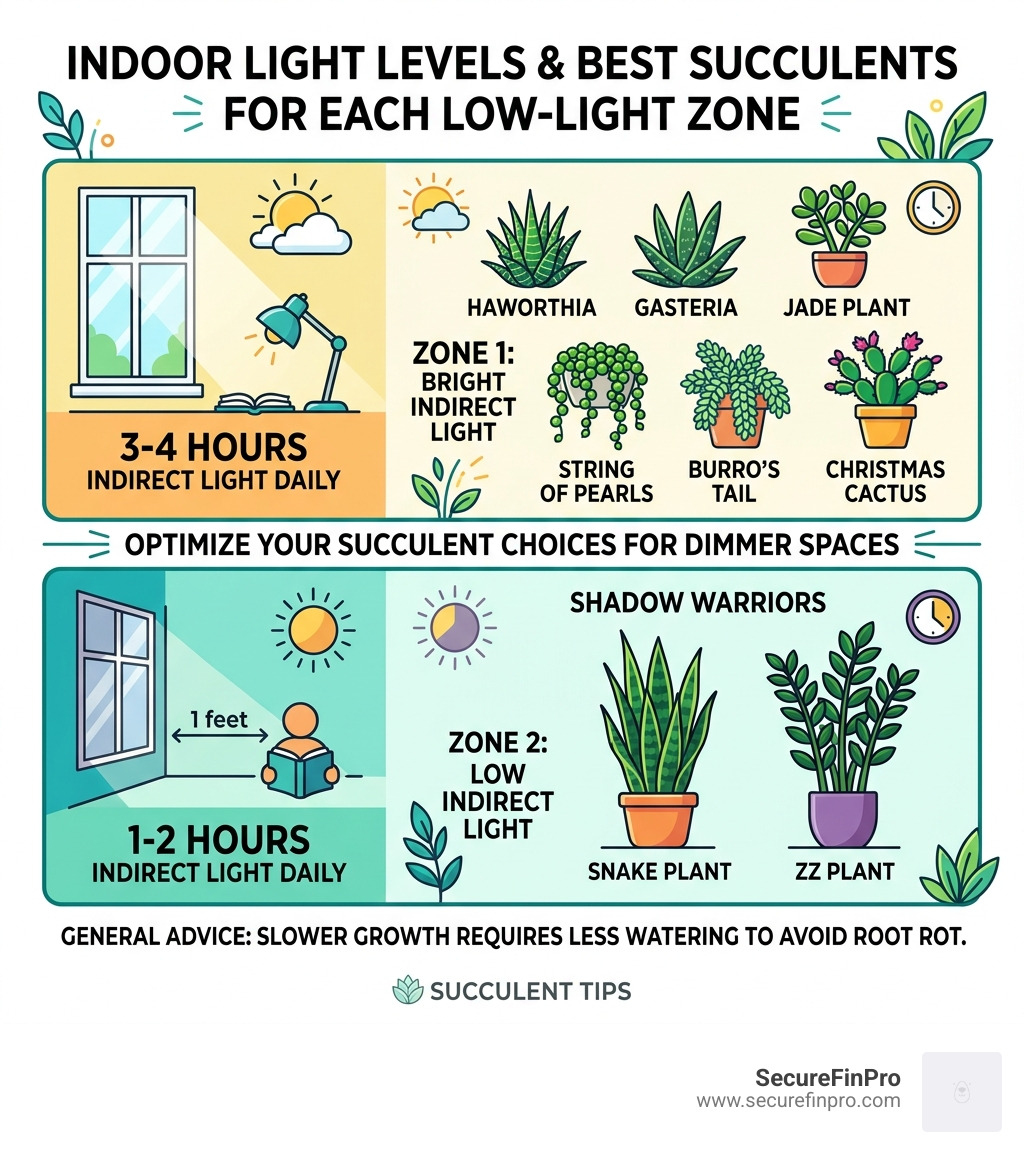
| Succulent | Type | Min. Light Needed |
|---|---|---|
| Snake Plant | Tall/upright | 1-2 hours indirect |
| Haworthia | Rosette | 3-4 hours indirect |
| Gasteria | Rosette | 3-4 hours indirect |
| ZZ Plant | Tall/upright | 1-2 hours indirect |
| Jade Plant | Shrub | 3-4 hours indirect |
| String of Pearls | Trailing | 3-4 hours indirect |
| Burro’s Tail | Trailing | 3-4 hours indirect |
| Christmas Cactus | Trailing | 3-4 hours indirect |
Most succulents need at least six hours of direct sun per day. But this group – sometimes called “shadow warriors” – thrives on just 3 to 4 hours of indirect light per day. Some, like Snake Plant and ZZ Plant, can survive on even less.
The tricky part is not the light. It’s everything that changes because of the light.
Less light means slower growth. Slower growth means the soil stays wet longer. And wet soil sitting too long is the number one killer of indoor succulents. If you’ve watched a succulent slowly go mushy on your windowsill, that’s probably what happened.
The good news: once you understand which plants to choose and how to adjust your care routine, low-light succulents are some of the easiest plants you can own. Learn more about understanding succulent sunlight needs before you start.
Top 15 Indoor Succulents for Low Light Environments
When we talk about indoor succulents low light, we aren’t talking about a dark closet. In the plant world, “low light” generally refers to a spot that receives no direct sun but is bright enough to read a book comfortably during the day. Think of a north-facing window or a corner several feet away from a sunny pane.
Choosing the right species is half the battle. Many colorful succulents, like the bright pink or purple Echeverias, will quickly lose their hue and stretch toward the light if kept in the shade. However, green-heavy varieties are often rich in chlorophyll, allowing them to process the limited light they receive much more efficiently. These “shade-tolerant” plants often exhibit slower growth, which makes them perfect for office desks or bookshelf decor where you don’t want a plant taking over the room in a month.
To help you build your indoor garden, check out this list of top succulent varieties for low-light conditions.

Best Rosette Indoor Succulents for Low Light
Rosette succulents are shaped like flowers, with leaves radiating from a central point. While many desert rosettes crave high sun, these varieties are the exceptions:
- Haworthia (Zebra Plant): These are perhaps the ultimate low-light succulents. Native to South Africa, they often grow under the shade of rocks or bushes. The Zebra Haworthia features striking horizontal white stripes and grows only 5-10 inches tall, making it an ideal desk companion.
- Haworthiopsis concolor: This slow-growing beauty has pointed bright green leaves with raised white spots. It is incredibly low-maintenance and thrives in filtered sunlight.
- Gasteria (Ox Tongue): Named for its tongue-shaped leaves, Gasteria is a close relative of Aloe but much more tolerant of shade. It produces beautiful orange flowers even in lower light conditions.
- Lace Aloe: Unlike its sun-loving cousin Aloe vera, the Lace Aloe (Aristaloe aristata) handles indoor conditions with grace, maintaining its dark green, white-spotted rosettes in indirect light.
- Hens and Chicks (Sempervivum): While these usually prefer the outdoors, certain varieties can adapt to bright indoor windowsills without the harsh afternoon sun.
- Blue/Gray Echeveria: If you must have an Echeveria, stick to the blue or gray-leaved varieties. They tend to hold their shape better in lower light than the vibrant reds or purples.
Trailing and Tall Indoor Succulents for Low Light
If you want to add height to a corner or have vines cascading from a high shelf, these “indestructible” varieties are your best bet:
- Snake Plant (Sansevieria): Often called “The Tank,” this plant is virtually unkillable. It can survive in very low light or even artificial office lighting. It stores water in its upright, sword-like leaves, meaning you can almost forget it exists and it will still look great.
- ZZ Plant (Zamioculcas zamiifolia): The ZZ plant looks so glossy and perfect that people often mistake it for plastic. It stores water in thick rhizomes underground and is one of the few plants that can truly handle a windowless room if there is enough overhead fluorescent light.
- Burro’s Tail (Sedum morganianum): This is a rare succulent that actually thrives in low light compared to its sun-hungry relatives. Its blue-green, teardrop-shaped leaves trail down in long, heavy braids that can reach 2 to 4 feet.
- String of Pearls: Known for its pea-like leaves, this trailing plant loves bright, indirect morning sun. It’s a fast grower when happy and looks stunning in a hanging basket.
- String of Hearts: Also known as Rosary Vine, this plant features delicate heart-shaped leaves and can trail up to 3 feet. It’s more of an epiphyte, meaning it likes a bit more humidity than your average cactus.
- Panda Plant (Kalanchoe tomentosa): This “fuzzy” succulent is often called “pussy ears” because of its soft, velvety leaves. It grows 12-18 inches tall and is quite happy in indirect light.
- Ponytail Palm: Despite the name, this is actually a succulent cousin of the Yucca. Its bulbous trunk stores water, and its long, curly leaves can handle the dry air of most homes.
- Christmas Cactus: Unlike desert succulents, this is a jungle native. It prefers dappled light and slightly more frequent watering than a cactus.
Master the Care: Watering, Soil, and Temperature
Growing indoor succulents low light requires a shift in mindset. Because these plants aren’t under the hot sun, they don’t “sweat” (transpire) as much. This means the water you give them stays in the soil much longer.
The golden rule for low-light succulents is the “Soak and Dry” method. You should water the soil thoroughly until water runs out of the drainage holes, then wait until the soil is 100% bone dry before watering again. In a low-light environment, this might only happen once every 3 to 4 weeks. During the winter, you may only need to water once every six weeks.
Temperature is also key. Most indoor succulents prefer a range between 60°F and 80°F. While they can handle the dry air of an air-conditioned office, they don’t like cold drafts. If you’re comfortable, they usually are too. Ensuring proper light levels for indoor succulents is the first step, but the soil is what keeps them alive.
Soil and Potting Requirements
Standard potting soil is the enemy of the succulent. It holds onto moisture like a sponge, which leads to the dreaded root rot. Instead, use a gritty cactus or succulent mix. We recommend amending store-bought mixes with 50% perlite, pumice, or coarse sand to ensure maximum drainage.
The pot matters just as much as the dirt. Terracotta pots are ideal for low-light succulents because the clay is porous, allowing the soil to “breathe” and dry out faster. Whatever material you choose, it must have drainage holes. Without them, water pools at the bottom, and your plant’s roots will literally drown.
Troubleshooting Etiolation and Common Pests
Even the best-cared-for plants run into trouble. The most common issue with indoor succulents low light is etiolation. This is a fancy word for “stretching.” When a succulent doesn’t get enough light, it starts growing rapidly upward, creating wide gaps between the leaves as it searches for a sunbeams.
If your plant starts looking “leggy,” it’s telling you it needs more light. You can fix this by moving it closer to a window or rotating the pot a quarter-turn every week to ensure all sides get even exposure. If it’s already too far gone, you can “behead” the plant, let the top callus over, and replant it as a shorter, sturdier version.
Managing Growth Habits
Different succulents react to low light in different ways. Trailing plants might get thinner vines, while rosette types might flatten out their leaves to maximize surface area for light absorption.
| Growth Type | Low Light Reaction | Maintenance Tip |
|---|---|---|
| Rosette (Haworthia) | Leaves may flatten or lose “window” clarity | Rotate weekly; check for “stress” colors (red/brown) |
| Trailing (Burro’s Tail) | Stems become thin; leaves fall off easily | Avoid touching; prune long, thin stems to promote bushiness |
| Upright (Snake Plant) | Growth slows to a near-halt | Wipe leaves with a damp cloth to remove dust |
Pests are less common indoors but can still appear. Mealybugs—tiny white cottony spots—are the most frequent uninvited guests. You can treat them by dabbing the bugs with a cotton swab dipped in 70% rubbing alcohol. For larger infestations, a mild pesticide spray or neem oil can help. For more specific care, see this guide on how to grow and care for Zebra Haworthia.
Propagation and Grow Light Optimization
One of the best things about succulents is that they are the “gifts that keep on giving.” Many low-light varieties, like Haworthia and Snake Plants, produce “pups” or offsets. These are baby plants that grow from the base of the mother plant.
To propagate, simply wait until the pup is about one-third the size of the parent, gently pull it away (ensuring it has some roots), let the wound “callus” or dry for 1-2 days, and then plant it in its own pot. For trailing plants like String of Pearls, you can simply snip a stem, remove a few leaves at the base, and stick it back into the soil.
Supplemental Lighting Tips
If your “cave” is truly dark, or you want your plants to grow faster and perhaps even bloom, you should consider a succulent garden lighting guide.
Modern LED grow lights are affordable, energy-efficient, and don’t have to look like a science experiment. Look for bulbs with a 3000K to 5000K color temperature (which mimics natural sunlight).
- Duration: Keep grow lights on for 6 to 8 hours a day.
- Distance: Place the light about 6-12 inches away from the plants.
- Timers: Use a cheap outlet timer so you don’t have to remember to flick the switch.
With a little supplemental light, even a windowless basement can become a succulent sanctuary. For more technical details, refer to our extended lighting guide.
Frequently Asked Questions and Conclusion
At SecureFinPro, we know a well-kept home is about more than budgets, paperwork, and planning – it is also about creating a space that feels calm and lived-in. Growing indoor succulents low light is a rewarding hobby that teaches patience and observation. By choosing “shadow warriors” like the Snake Plant or Haworthia and being disciplined with your watering can, you can maintain a lush indoor garden in the dimmest of spaces.
Can succulents survive in a room with no windows?
No plant can survive in total, pitch-black darkness forever. Plants need light to create food (photosynthesis). However, “indestructible” plants like the Snake Plant or ZZ Plant can survive for months in very dim conditions. To keep them healthy long-term in a windowless room, you must use a supplemental grow light for at least 6-8 hours a day.
How often should I water succulents in low light?
In low light, evaporation happens much slower. You should generally water every 3 to 4 weeks. The best way to tell is to stick your finger two inches into the soil; if it feels even slightly damp, wait. Always err on the side of underwatering – a thirsty succulent is easy to fix, but a rotted one is usually a goner.
Why is my low-light succulent turning yellow?
Yellow, mushy leaves are almost always a sign of overwatering or poor drainage. If you see this, stop watering immediately and let the soil dry out completely. Ensure your plant is in a gritty cactus mix and that your pot has a drainage hole. If the stem is black and soft, you may need to take a healthy cutting and start over.
Ready to start your collection? Explore our top succulent varieties for low-light conditions and turn your dim corner into a small indoor garden today!
